
After supporting thousands of professionals with career development, Keith Lawrence Miller brought organizational psychology, deep coaching experience, résumé strategy, and recruiting together in Recruiting Mastery, a practical operating manual for finding talent, establishing evidence, and making better hiring decisions.
By Keith Lawrence Miller, M.A. ·
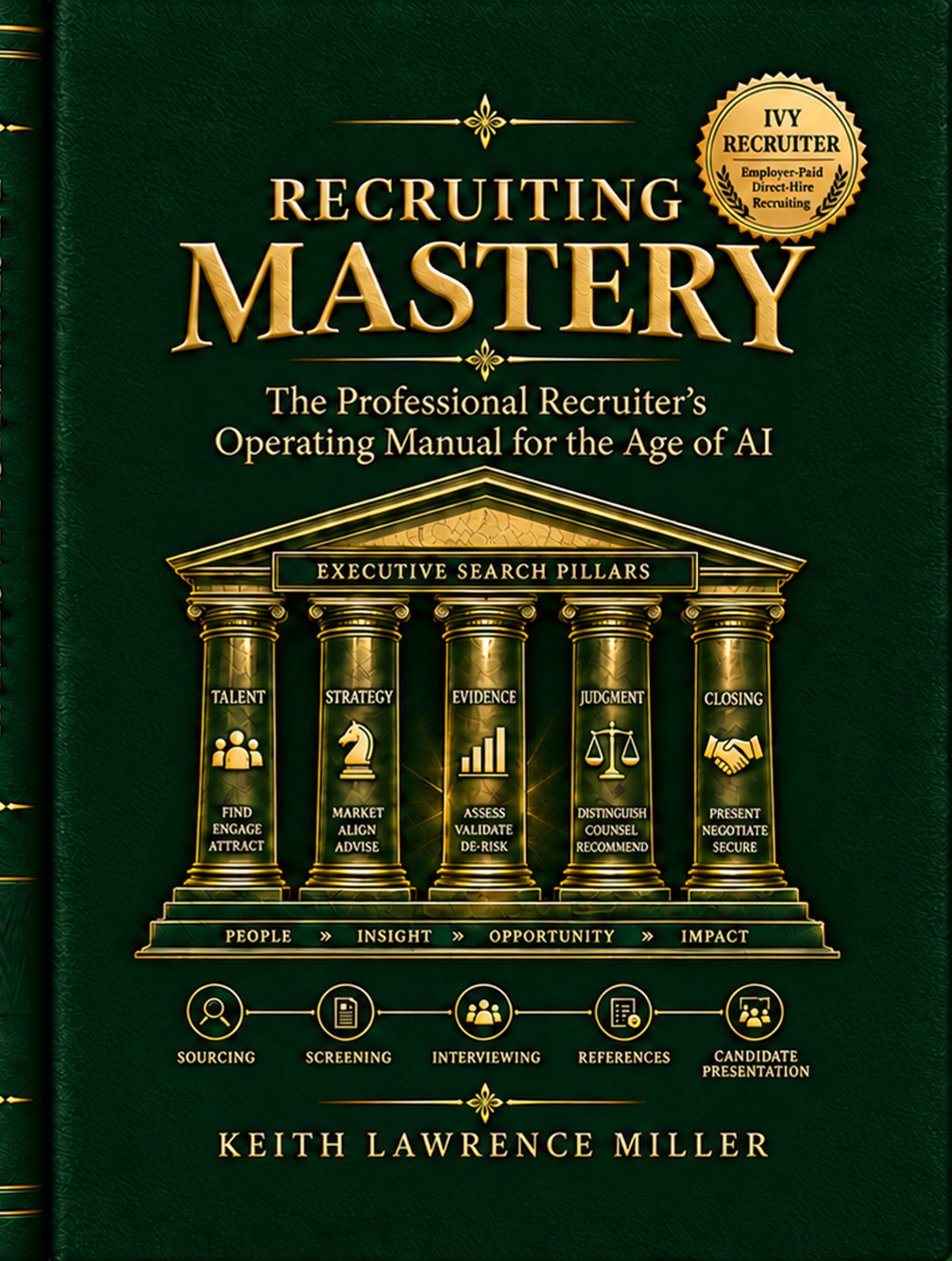
From Recruiting Mastery by Keith Lawrence Miller, M.A.

My understanding of recruiting grew out of years spent trying to understand people at work.
For more than fifteen years, I have worked with professionals across industries, functions, seniority levels, and career stages. Some were trying to enter the workforce. Others were navigating a promotion, a layoff, a career change, a return to work, an executive transition, or a move into the C-suite. I have worked with emerging professionals, senior executives, entrepreneurs, board candidates, PhDs, MBAs, and leaders responsible for complex organizations.
Thousands of people have trusted me with the same underlying challenge: help me understand what I have done, what I am capable of doing, and how to communicate that value accurately.
That experience changed how I see talent.
A résumé may contain only a few pages, but the person behind it carries years of decisions, setbacks, achievements, relationships, learning, pressure, ambition, and adaptation. Some people understand their value immediately. Others have performed at a high level for years and still struggle to explain what made their contribution important.
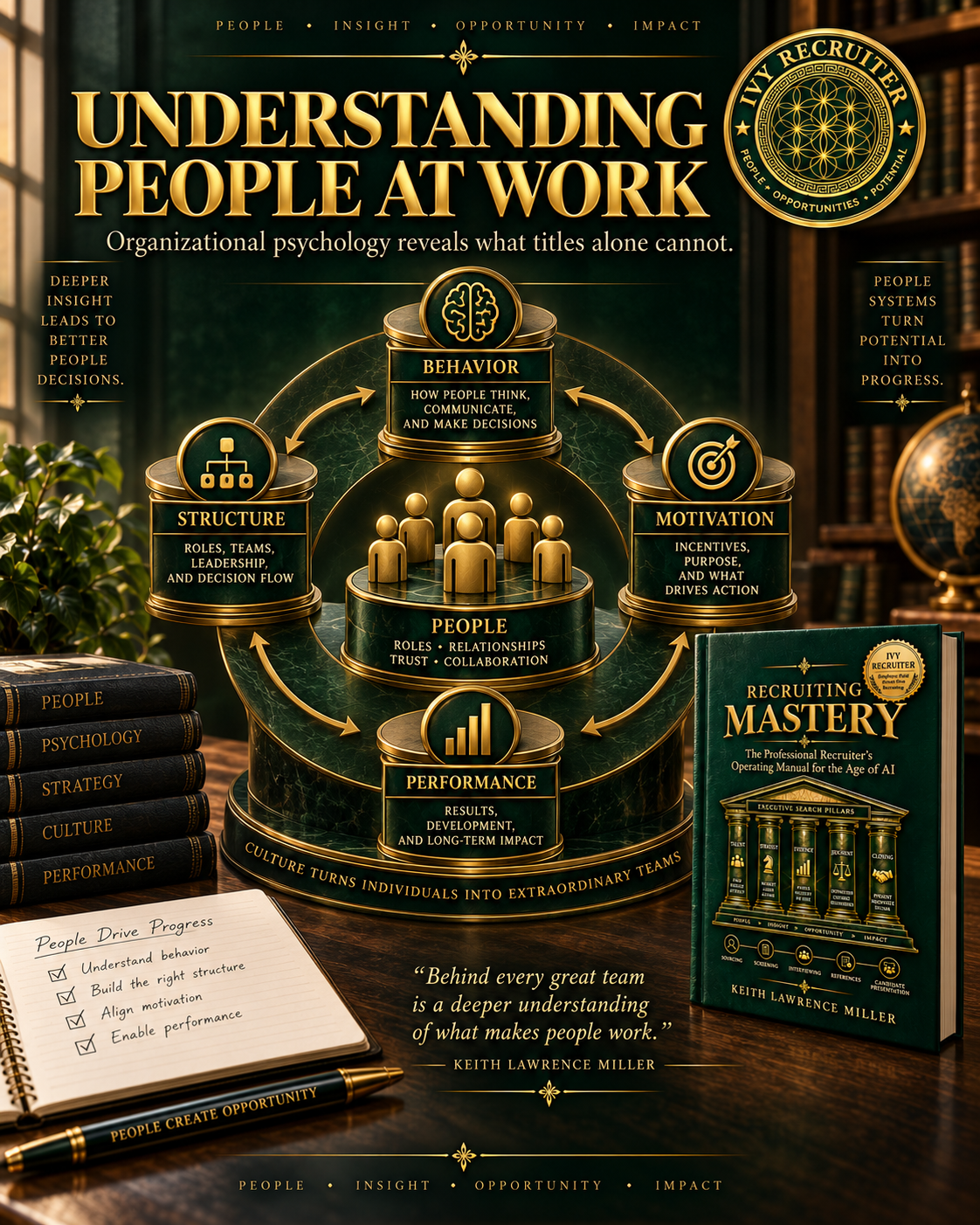
My work in organizational psychology gave me a deeper lens for those conversations. Instead of looking only at titles and accomplishments, I became interested in the systems surrounding performance. What was the person responsible for? What authority did they actually have? What conditions made the work difficult? How did motivation, leadership, culture, structure, incentives, communication, or relationships affect the outcome? Which capabilities belonged to the individual, and which results depended on the larger system?
Coaching added another dimension.
Deep coaching work teaches you to listen beyond the first answer. A client may say they want a new job when the real issue is stalled development. Someone may believe they lack confidence when the deeper problem is that they have never translated their experience into evidence they can trust. A senior leader may describe an accomplishment in terms so broad that even they have lost sight of what they personally decided, influenced, or built.
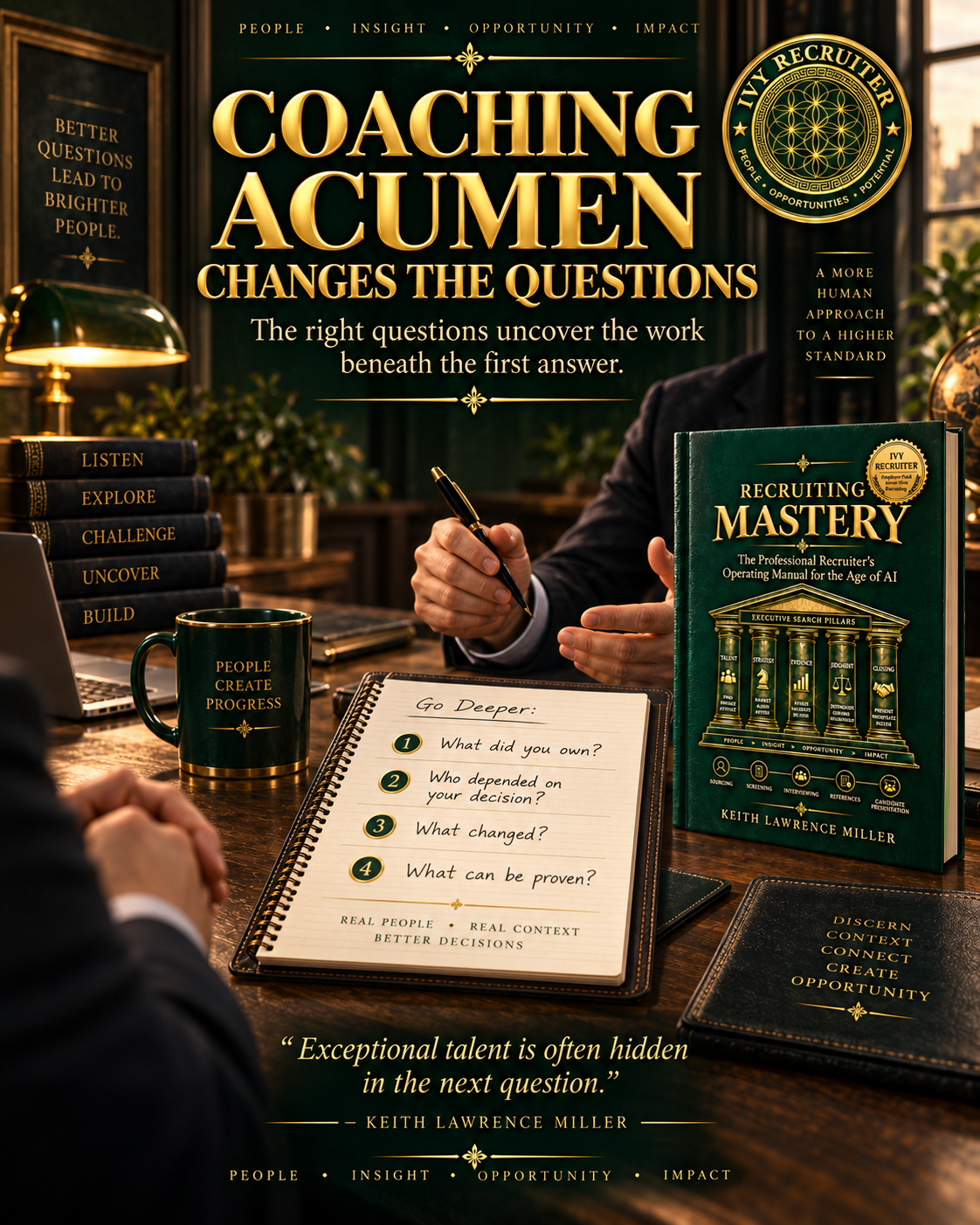
Over time, I became accustomed to asking questions that moved past the surface: What did you actually own? Who depended on your decision? What changed because of your work? What part belonged to the team? What did you learn? What can you now do that you could not do before? Where did the result come from? What would another person need to see before believing the claim?
Those questions began in career development.
Eventually, they led directly into recruiting.
The manuscript reflects that professional progression. My work since 2009 has connected career strategy, executive positioning, résumé development, coaching, recruiting, and organizational and business psychology. Each discipline helps sharpen the question, clarify a claim, and identify who actually owns the decision.
That combination became the foundation of Recruiting Mastery.
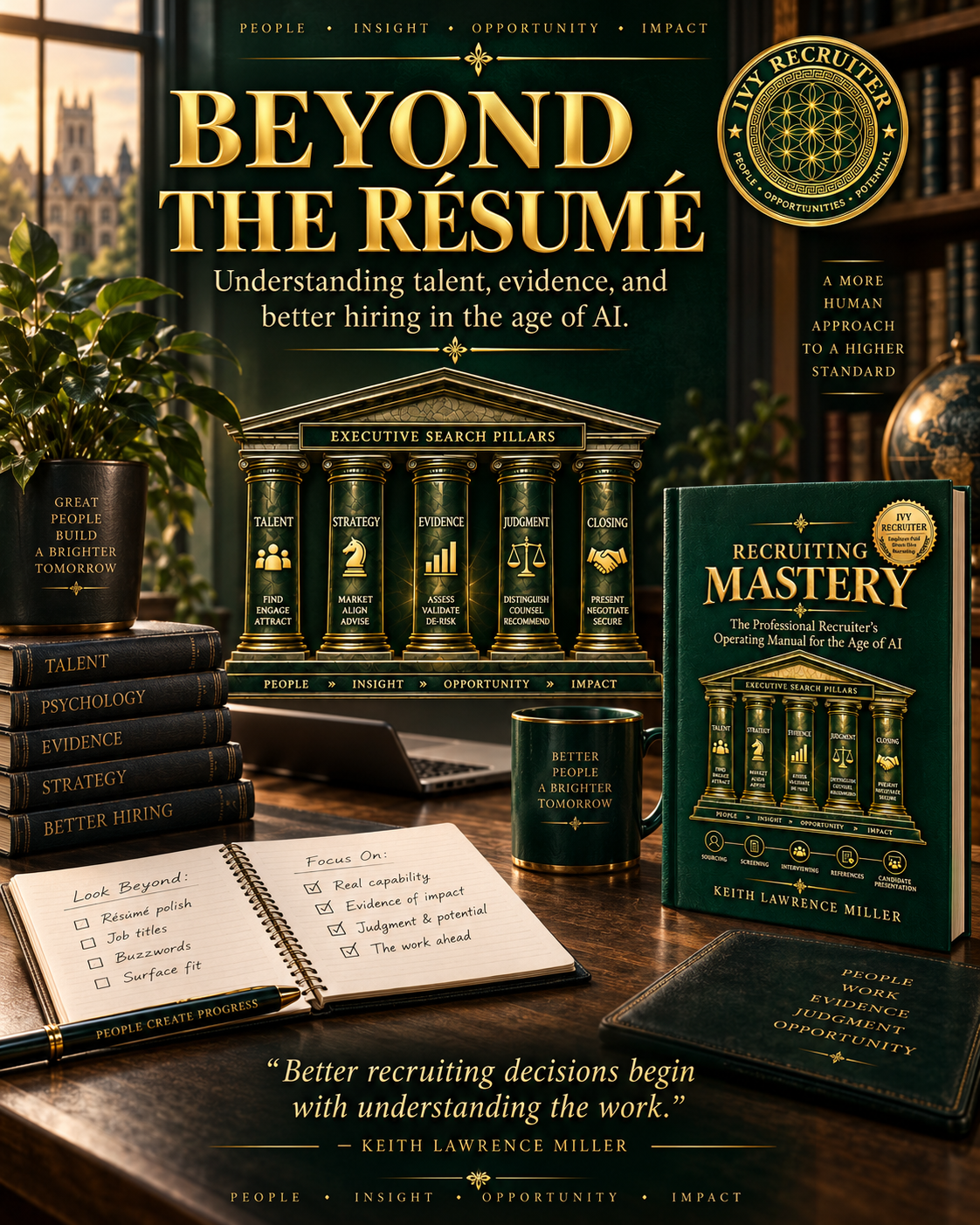

Supporting Candidates Taught Me How Much Capability Can Be Hidden
Years of résumé and career work taught me something recruiters should never forget: presentation quality and capability are not the same thing.
A strong professional can have a weak résumé.
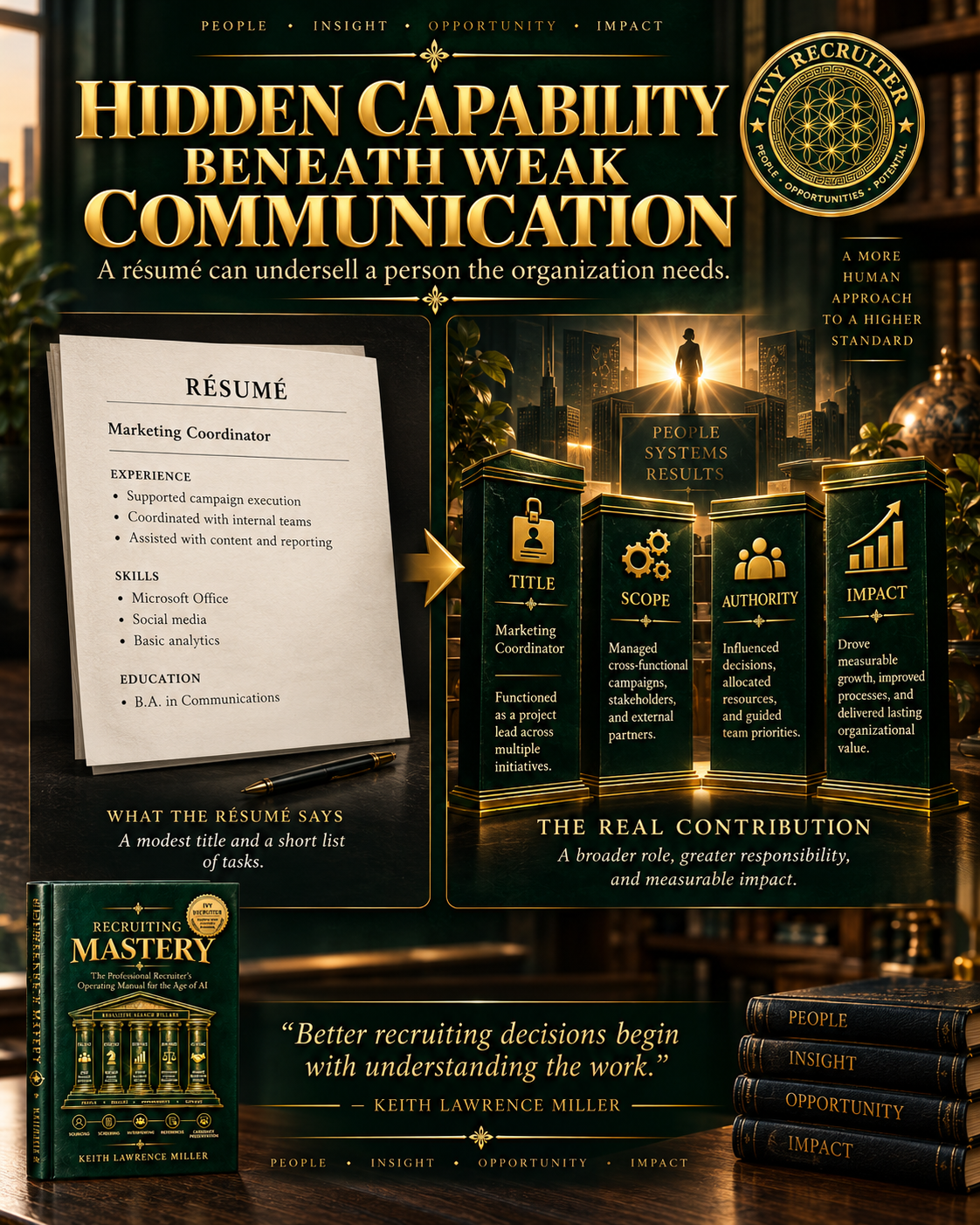
A person may have managed large teams, transformed operations, built programs, reduced costs, developed leaders, improved service, repaired broken processes, or carried significant financial responsibility while describing all of it in language that sounds ordinary.
I have seen this repeatedly.
The problem is often not a lack of accomplishment. The person has never been taught how to identify the accomplishment correctly.
Someone writes, “supported managers,” when they actually supervised five managers and held responsibility for their performance.
Someone writes, “helped with operations,” when they were making decisions across multiple locations.
Someone leaves out scale, authority, budget responsibility, complexity, or consequences because those facts became normal to them.
Coaching reveals what the résumé hides.
That experience shaped one of the most important ideas in Recruiting Mastery: an employer should never assume that the quality of a document equals the quality of the person represented by it.
A weak document should create questions before it creates a verdict.
Organizational Psychology Changed the Questions I Ask About Talent
Recruiting becomes more intelligent when we stop treating the individual as though performance occurs in isolation.
People operate inside systems.
A leader's results can depend on the authority they were given, the quality of the team, market conditions, organizational resources, incentives, technology, culture, executive sponsorship, timing, and dozens of other variables.
Organizational psychology trained me to pay attention to those relationships.
If someone tells me they transformed an operation, I want to know what the original problem was. What authority did they possess? Who resisted the change? What resources were available? What decisions belonged to someone else? How was success measured? What alternative explanation might account for part of the result?
The goal is not to make every accomplishment suspicious. The goal is to understand it accurately.
The same reasoning applies when evaluating a career gap, a nontraditional background, a promotion, a lateral move, or a candidate whose title appears smaller than the work.
Context does not eliminate personal responsibility. It makes the evidence more meaningful.
That is one of the reasons Recruiting Mastery begins with the job rather than the applicant.
Before evaluating people, the recruiter needs to understand the system the person is being asked to enter.
Recruiting Begins With Understanding the Work
A recruiter can search thousands of profiles without understanding what the employer actually needs.
Technology has made that easier than ever.
Give a system a title, location, list of keywords, and preferred years of experience and it can begin returning names almost immediately.
Speed creates the impression that recruiting has begun.
Professional recruiting begins earlier.
What problem does the employer need solved? What must the person accomplish? What decisions will they own? Who will report to them? Which capabilities must exist on the first day? Which gaps can the organization realistically teach? What support will exist after the hire? What evidence would persuade us that a person can perform the essential work?
The fictional Pluto V Corp case in the book demonstrates how dramatically those questions can change a search.
The initial job description looks familiar: ten years of industry experience, an MBA, a recognizable prior employer, expertise in a specific software product, and “executive presence.”
Once the recruiter investigates the work, the actual requirements become more precise.
The new regional director needs to manage managers across multiple locations, protect service and safety during change, make sense of inconsistent operating information, and implement improvements that can survive outside a presentation deck. The employer can teach its particular software and provide domain support. It cannot spend months teaching someone the fundamentals of managing managers.
That changes the recruiting problem.
Instead of searching for a biography that resembles the job description, the recruiter can search for evidence of the work.
Titles Are Useful Until They Hide the Person You Need
Career development taught me how unreliable titles can be.
Organizations title jobs differently.
Responsibilities grow faster than titles.
A small organization may give someone extraordinary scope under an ordinary title.
A large corporation may give someone an impressive title with much narrower authority.
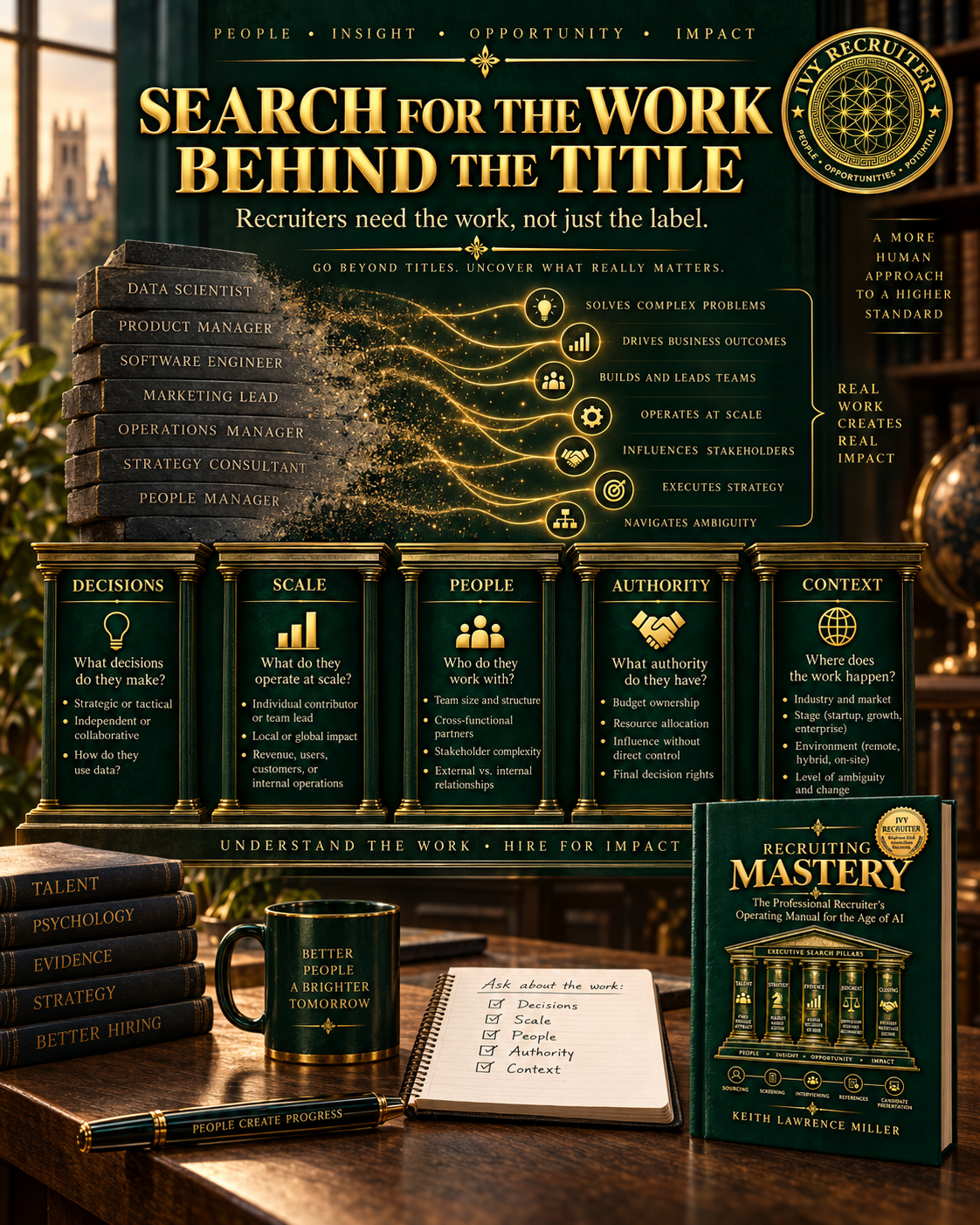
The book therefore tells recruiters to search for the work behind the title.
A regional leader may be called a Regional Operations Director at one company, an Area Manager somewhere else, a Network Lead in another organization, or even retain a Coordinator title after the role has expanded substantially.
That does not mean titles are irrelevant.
They are clues.
The recruiter has to understand what the title represented in that organization.
The sourcing process becomes stronger when the search includes tasks, decisions, scale, authority, settings, and accomplishments instead of relying only on familiar labels.
A search result is the beginning of an investigation rather than proof of qualification, availability, interest, or consent.
That distinction creates room for exceptional people who would otherwise remain invisible.
The Diamond in the Rough Has to Survive Investigation
I have spent years helping people identify strengths that were buried beneath weak communication.
That naturally makes me interested in overlooked candidates.
But professional recruiting cannot become a celebration of the underdog.
The unconventional candidate should not receive an automatic advantage simply because the story is compelling.
The candidate has to establish the work.
In the fictional case, Riley Chen provides the book's clearest example.
The résumé barely explains the scope of the role. A public presentation about standardizing dispatch procedures across five hubs creates a clue that there may be more behind the document.
That clue justifies investigation.
It does not justify a recommendation.
The inquiry then asks whether Riley actually managed managers, what authority existed, what decisions belonged to Riley, how operating information was interpreted, and which results can be supported.
As the fictional evidence develops, some of Riley's initially hidden experience becomes more substantial.
Other gaps remain.
That is exactly how the process should work.
The book's principle is direct:
Curiosity starts the investigation. Evidence determines whether it continues.
This is the discipline that prevents an overlooked candidate from becoming another kind of bias.

Coaching Acumen Matters in Recruiting
Good recruiters need more than sourcing skills.
They need to know how to conduct conversations that help people explain difficult experiences accurately.
That does not mean coaching candidates toward a preferred answer.
It means knowing how to ask questions that uncover useful information.
A weak interviewer hears, “I led a major transformation.”
A stronger interviewer asks what part the candidate personally owned, who reported to them, which decisions they could make without approval, what the sponsor owned, what the program budget actually represented, how the result was measured, and what another source could reasonably confirm.
Coaching experience develops this kind of listening.
It also helps when the candidate is uncertain, nervous, overly modest, overly broad, or struggling to find the language for complicated work.
Some professionals require clarification rather than evaluation during the first few minutes of a conversation.
The recruiter still maintains the standard.
The recruiter simply becomes better at collecting the evidence needed to apply it.
A Résumé Contains Claims. Recruiting Has to Establish Their Status.
This is where my résumé background and recruiting work come together most directly.
A résumé is a professional narrative.
It is not an independently verified record.
That distinction protects candidates as much as employers.
When a résumé says someone “led” something, the appropriate response is not suspicion. It is clarification.
What did led mean?
If a résumé reports a 28 percent improvement, the recruiter needs to understand the measure.
If someone describes a $30 million transformation, the recruiter should determine whether $30 million represents the person's budget authority, total program funding, or simply the environment in which the candidate worked.
The book repeatedly asks recruiters to preserve evidence status.
A statement may be candidate-reported, observed in a work sample, document-reviewed, reference-corroborated, or still unestablished.
Those labels are attached to individual claims rather than to the candidate's character.
A person can have a corroborated reporting relationship, a candidate-reported performance result, and an unresolved explanation of causation in the same file.
That is normal.
Professional judgment becomes stronger when uncertainty remains visible.
The Interview Should Create Comparable Evidence
Interviews can create powerful impressions.
That is part of their danger.
One candidate is charismatic.
Another is thoughtful but slower.
Someone speaks with confidence.
Another person needs a moment to formulate the answer.
One résumé has prepared the interviewer to expect excellence.
Another has already created doubt.
A structured interview does not remove human judgment.
It gives judgment something more disciplined to work with.
In the book's fictional search, candidates receive common questions tied to four essential requirements: service and safety judgment, management of managers, defensible use of data, and realistic implementation.
The follow-up questions differ where each candidate's claims require clarification.
The standard does not.
That distinction allows recruiters to examine different career histories without turning consistency into mechanical sameness.
Candidate Experience Is Part of the Quality of the Decision
Years of coaching also taught me what hiring processes feel like from the other side.
Candidates rearrange schedules, prepare for interviews, research organizations, complete assessments, wait for updates, and make decisions about whether they can risk leaving an existing job.
They often have very little visibility into what is happening.
That matters ethically.
It also matters to the quality of the evidence.
If a process requires a candidate to perform unrelated behaviors, the employer may begin evaluating the process instead of the capability.
A one-way video interview can accidentally make camera behavior more important than the work.
A timed written exercise can reward typing speed when typing speed has nothing to do with the job.
An inaccessible platform can prevent a capable person from participating before their actual ability is ever observed.
Candidate experience therefore belongs inside professional recruiting, not outside it as a branding exercise.
The question is simple:
Does the process give the candidate a reasonable way to demonstrate the capability the employer actually needs?
Commercial Pressure Tests Professional Judgment
Recruiting has commercial realities that career coaching does not always share.
Agencies need revenue.
Employers want vacancies filled.
Recruiters have targets.
Managers become impatient.
Candidates receive competing opportunities.
The closer a search gets to a placement, the more temptation exists to protect the transaction.
That is exactly when professional judgment matters most.
A recruiter who needs three finalists cannot manufacture a qualified third person.
A fee opportunity does not justify changing a candidate's experience.
A hiring manager's preference does not automatically become a legitimate screening rule.
An employer's eagerness does not create candidate consent.
A candidate's enthusiasm does not create an approved offer term.
The book treats these situations as operational decisions rather than abstract ethical debates.
Commercial pressure explains why judgment becomes difficult.
It does not change the evidence.
The Candidate Evidence Brief Grew From a Problem I Saw Repeatedly
After years of helping candidates communicate value, I became increasingly aware of the weakness in simply forwarding a résumé to an employer.
The document may be excellent.
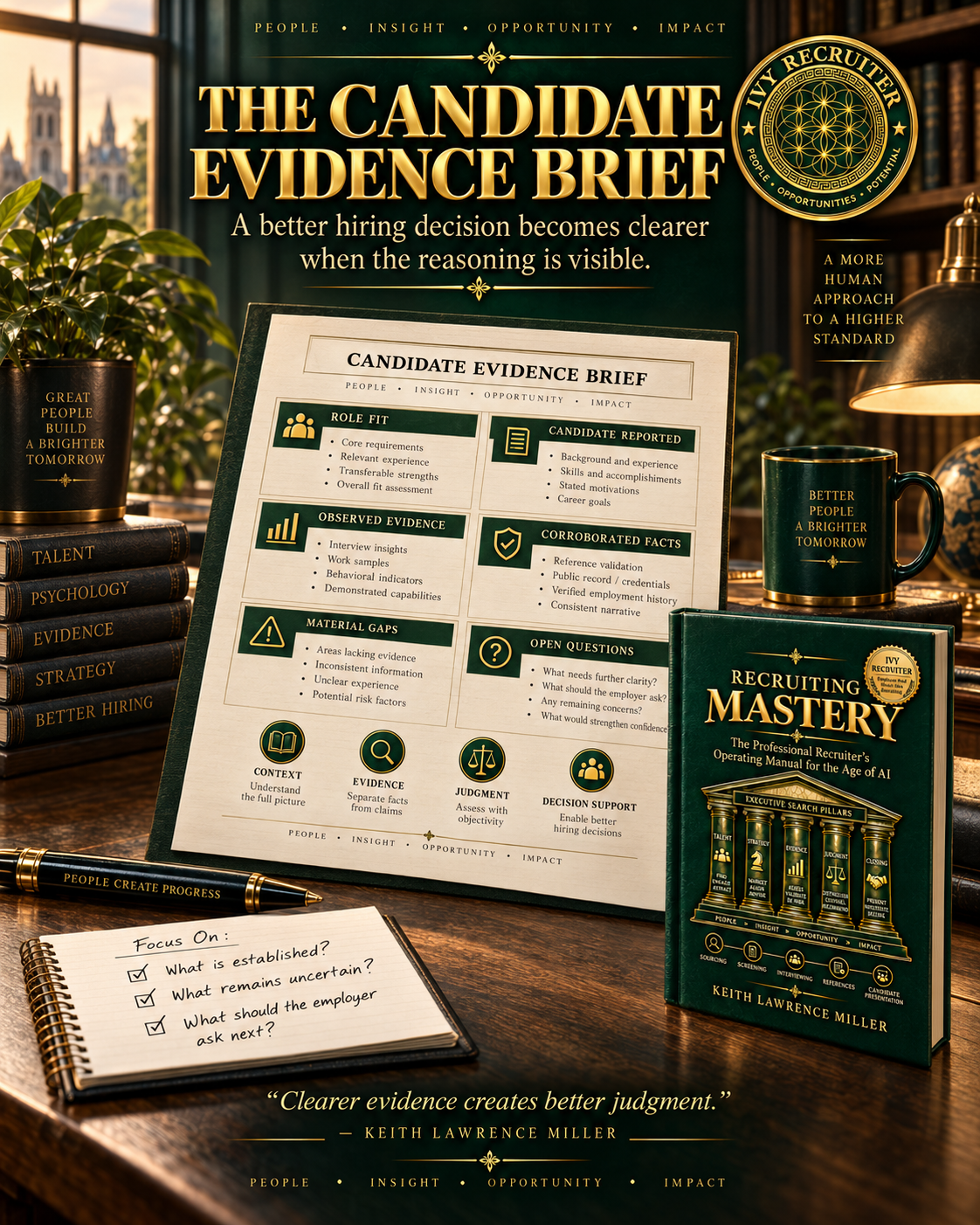
The employer still needs to know why the recruiter is presenting this person, which requirement their experience addresses, which parts of the story have been corroborated, where the candidate is strong, where the transfer risk exists, what remains uncertain, and what should be asked next.
That is the purpose of the Candidate Evidence Brief.
The brief is one of the central work products in Recruiting Mastery.
It sits beside the résumé rather than replacing it.
The résumé represents the candidate's professional history.
The Candidate Evidence Brief represents the recruiter's reasoning about this particular opportunity.
It distinguishes what the candidate reported, what the recruiter observed, what a reference or document corroborated, and what remains unknown. It also makes material gaps visible instead of hiding them behind persuasive language.
That matters for conventional candidates too.
A familiar background should never receive an exemption from evidence simply because the résumé already looks right.
Candidate Preparation Should Make the Truth Easier to See
My career-document work strongly influenced this section of the book.
I believe candidates should be presented well.
An employer should not have to decode poor writing to discover relevant capability.
If substantive screening establishes that someone actually supervised five managers, their résumé should not say merely that they “supported managers.”
Clarifying the truth is valuable.
Changing the truth is not.
A delegated operating budget should remain a delegated operating budget.
It should not become a full P&L simply because the stronger phrase sounds more executive.
A $30 million program should remain program context if the candidate never controlled $30 million.
An impressive organization-wide result should not become an individual accomplishment without evidence connecting the candidate to it.
The strongest document is the one that becomes clearer under scrutiny rather than weaker.
That principle sits at the intersection of résumé mastery and recruiting mastery.
AI Has to Earn Its Place
Artificial intelligence creates enormous potential in recruiting.
It can help identify language candidates may use for similar work, draft messages, summarize interviews, organize notes, compare a résumé with an approved brief, extract claims, and prepare a first draft of a Candidate Evidence Brief.
The technology becomes dangerous when polish is mistaken for proof.
A generated summary can upgrade “candidate said” into “confirmed.”
A model can smooth away a qualification that looked inconvenient.
A ranking system can produce a precise-looking score whose relationship to the job is impossible to inspect.
An AI-written outreach message can invent an employer preference or candidate accomplishment.
The issue is therefore larger than whether AI can perform the task.
The question is whether the complete workflow becomes better after review, correction, permission, and error repair are included.
That is why Chapter 26 is called AI That Earns Its Place in the Workflow.
The manuscript refuses to claim measured time savings, superior hiring outcomes, or ROI for the proposed AI exercises because those outcomes were not tested. AI remains an aid to professional work while accountability remains with the people responsible for the search.
That is exactly how I think AI should be approached.
Capability should not be confused with authority.

Recruiting Metrics Should Tell Us Whether the Decision Process Is Improving
Recruiting technology produces endless activity data.
Messages sent.
Profiles reviewed.
Applications received.
Screens completed.
Submissions made.
Interviews scheduled.
Offers issued.
Those figures can help manage work.
They do not automatically tell us whether the recruiting decisions are improving.
A recruiter can send more messages because targeting became worse.
A team can increase submissions by lowering the quality of the slate.
Time-to-fill can fall because important verification steps disappeared.
An assessment can reduce recruiter time while increasing candidate burden.
The book therefore asks recruiters to measure decisions, not only activity.
Did the role become clearer?
Did the search expose relevant people who title-only sourcing missed?
Were interview decisions supported by actual evidence?
Were unsupported candidate claims reduced?
Were corrections made before presentation?
Were candidates updated when promised?
Did the person actually start?
What happened after ninety days?
Did the employer provide the resources it promised during hiring?
The useful metric is tied to the decision we are trying to improve.
Recruiting Does Not End at Offer Acceptance
The career-development side of my work made this especially clear.
An offer is a major decision for a person.
It can change income, family routines, commute, location, career direction, identity, and future opportunity.
The candidate deserves an accurate understanding of what they are accepting.
The employer deserves to know what the candidate believes was promised.
The recruiter therefore has to keep distinctions clear.
Selection is one event.
An offer is another.
Acceptance is another.
A confirmed start is another.
Performance after the start is another.
The agency's invoice and cash collection are different events again.
Collapsing those steps creates bad records and false certainty.
The book deliberately carries the recruiting process through the actual start and then into post-hire learning.
The First 90 Days Complete the Learning Loop
Recruiters rarely control what happens after a person joins.
That does not mean the outcome has nothing to teach us.
A first-90-day review can reveal whether the assumptions made during the search held up.
Was the job accurately described?
Did the candidate possess the capabilities we thought were transferable?
Did the gap we identified matter?
Was the employer support actually provided?
Did a supposedly essential credential turn out to be irrelevant?
Did a risk we underestimated become significant?
Did the new hire encounter an organizational problem no candidate could reasonably have solved alone?
This information should improve the next search.
Recruiting becomes more professional when every hiring decision produces learning rather than simply a placement statistic.
Mastery Is Visible in the Work
The word mastery can easily become promotional.
I use it differently.
A recruiter can know the vocabulary of recruiting and still make a poor decision.
Someone can memorize frameworks, complete courses, collect certifications, and still send a candidate whose essential qualification was never established.
The final chapter of the book therefore brings mastery back to observable work.
Can another professional inspect the search brief?
Can they understand why a sourcing strategy was chosen?
Can they trace an important claim to its source?
Can they see where uncertainty remained?
Can they determine why the recruiter recommended an interview?
Can they see how a correction changed the decision?
Can they tell what belonged to the recruiter, the candidate, the employer, or a specialist?
That is mastery I can respect.
The book's 26 competency areas are presented as teaching and development material rather than a validated test, established passing score, or accredited credential.
The work product matters more than the label.
Why I Wrote Recruiting Mastery
My career has given me unusual exposure to the entire employment conversation.
I have helped thousands of people understand their professional identities, communicate their value, prepare for interviews, negotiate transitions, navigate difficult career decisions, and develop as leaders.
Organizational psychology taught me to examine the system around the person.
Coaching taught me how to listen for what sits beneath the first answer.
Résumé work taught me how easily strong capability can disappear behind weak communication.
Recruiting added the responsibility of determining what the employer can reasonably conclude from the available evidence.
Those experiences eventually converged.
The result is Recruiting Mastery.
The book is built around a professional promise:
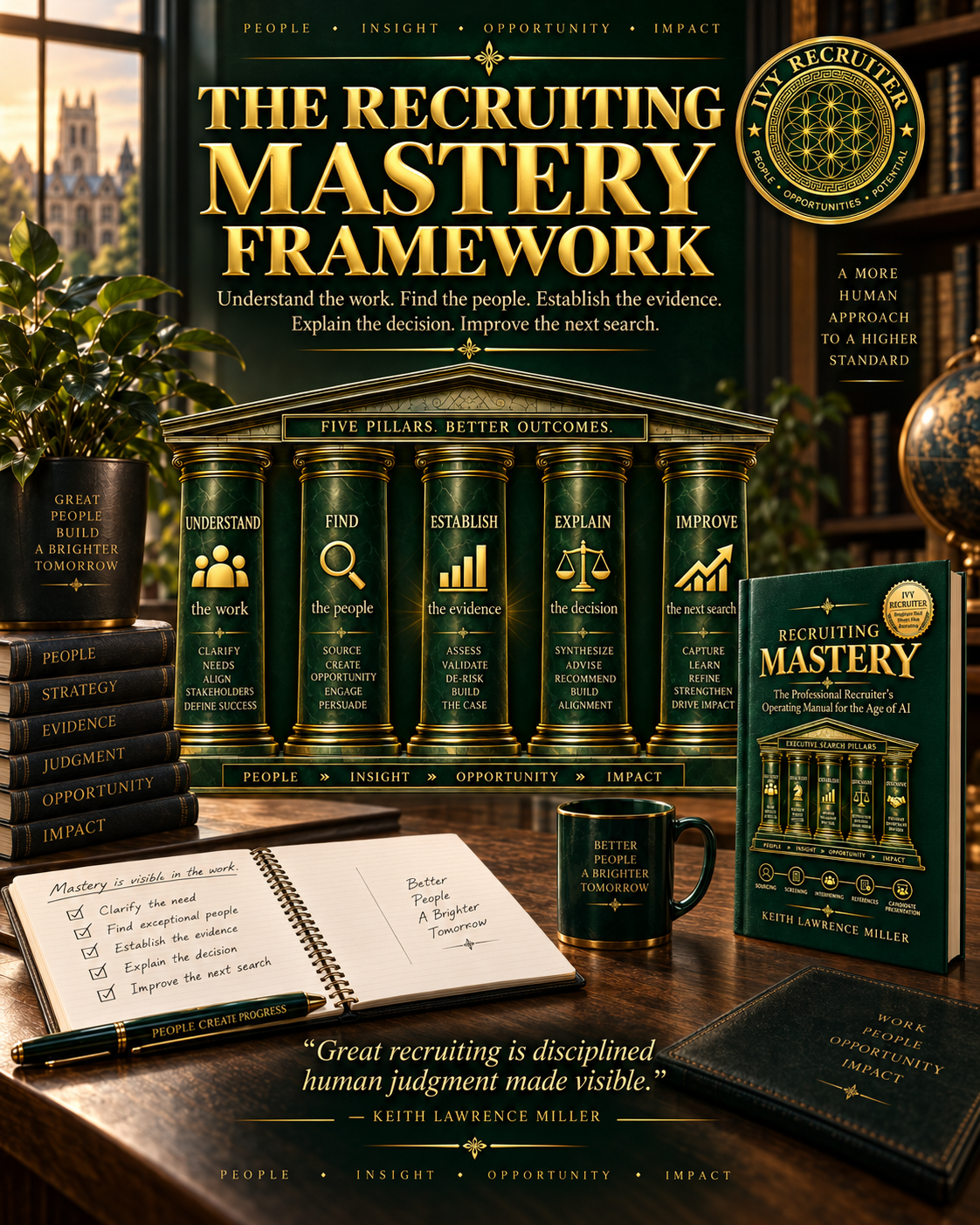
Understand the work. Find the people. Establish the evidence. Explain the decision. Improve the next search.
That sequence captures the kind of recruiter I believe organizations need in the age of AI.
The technology will become faster.
Search will become easier.
Documents will become more polished.
Candidate information will become more abundant.
None of those developments automatically produces better judgment.
Recruiting will continue to depend on professionals who can understand people, understand work, question assumptions, evaluate evidence, communicate uncertainty, respect consent, and help two parties make consequential decisions with greater clarity.
That is the standard behind this book.
That is what I mean by Recruiting Mastery.
About the Book
Recruiting Mastery: The Professional Recruiter's Operating Manual for the Age of AI is a 2026 professional manual by Keith Lawrence Miller that integrates recruiting practice with organizational psychology, career-development experience, evidence discipline, candidate communication, business judgment, and responsible technology use.
The book contains 28 chapters organized across seven parts:
Part I: Professional Responsibility examines recruiter responsibility, judgment under uncertainty, ethics under commercial pressure, and candidate experience.
Part II: Understanding and Authorizing the Search covers assignment qualification, defining success, essential versus preferred capabilities, learnable gaps, and market feasibility.
Part III: Finding and Engaging Talent addresses work-based sourcing, overlooked candidates, outreach, and talent relationships.
Part IV: Establishing Capability examines résumé claims, structured interviews, work samples, assessment limits, references, identity, and calibrated verification.
Part V: Presenting, Advising and Closing covers accurate candidate documents, the Candidate Evidence Brief, hiring-manager advisory, offers, negotiation, and the actual start.
Part VI: Running the Recruiting Business addresses agency economics, employer relationships, recruiting-team consistency, and first-90-day learning.
Part VII: Technology, Measurement and Mastery examines technology architecture, responsible AI use, decision-centered measurement, and continued professional development.
The manuscript uses Pluto V Corp, a completely fictional employer and case, so readers can practice difficult recruiting judgments without exposing confidential candidates or employers. It does not represent an Ivy Recruiter search or establish the effectiveness of any particular recruiting method.
The book also introduces the Candidate Evidence Brief, an employer-facing decision aid that distinguishes candidate-reported information, observed evidence, corroborated claims, material gaps, and unresolved questions.
Recruiting Mastery teaches professional judgment. Its exercises and worksheets are developmental tools rather than validated selection instruments, legal advice, guaranteed hiring methods, or an accredited recruiter credential.
Keith Lawrence Miller Copyright © 2026 ISBN: 9798178165027 Imprint: Independently published
About the Author's Perspective
Keith Lawrence Miller is a Columbia-trained organizational psychology practitioner, executive and career coach, résumé expert, author, entrepreneur, and recruiting practitioner. His work has supported thousands of professionals across industries, functions, and career stages and combines organizational psychology, career-development strategy, coaching, professional communication, emotional intelligence, and recruiting.
The Recruiting Mastery manuscript describes his professional work since 2009 as connecting career strategy, executive positioning, résumé development, coaching, recruiting, and organizational and business psychology.
Connection to Ivy Recruiter
The manuscript identifies Ivy Recruiter as Keith Lawrence Miller's independent, employer-paid direct-hire recruiting business. Its approach starts with the work the employer needs done, evaluates candidates against the relevant requirements, and uses the Candidate Evidence Brief to make the basis for a proposed introduction visible.
Looking for a recruiter who starts with the work?
Ivy Recruiter helps employers define the role, identify relevant talent, establish evidence, and make better hiring decisions.
Discuss a Hiring Need: https://ivyrecruiter.com/employers/request-search
See the Recruiting Process: https://ivyrecruiter.com/services/direct-hire-search
Read the candidate-presentation guide: https://ivyrecruiter.com/resources/candidate-presentation
Forms and account services are not yet available. For a recruiting conversation, email keith@ivyrecruiter.com.