
A selective hiring market calls for clearer requirements, relevant candidate evidence, and a more deliberate recruiting process.
By Keith Lawrence Miller, M.A. ·

Conceptual editorial illustration.
A selective hiring market calls for clearer requirements, relevant candidate evidence, and a more deliberate recruiting process.
Talent is the lifeblood of an organization.
When a business needs someone who can lead a function, solve an operating problem, strengthen a team, or deliver an important project, a vacancy is more than an empty position on an organization chart.
It is work that still needs to be done.
The U.S. economy recorded 29,000 net payroll additions in September 2026.[1] Slower employment growth does not make every specialist easy to recruit, and it does not remove the need to distinguish a relevant candidate from a plausible-looking résumé.
For employers, the question is not simply whether people are looking for work.
It is whether the hiring process can identify the people equipped to do the work that matters.
Start with the work, not an inherited job description
A job description should explain the need the organization is hiring to address.
What must the person accomplish? Which experience is essential? What can be learned? What authority will the role carry? Are compensation and working arrangements consistent with the search?
An unclear answer can create confusion at every later stage. Recruiters may source against different assumptions. Interviewers may use different standards. Candidates may discover late in the process that the role is not what they understood.
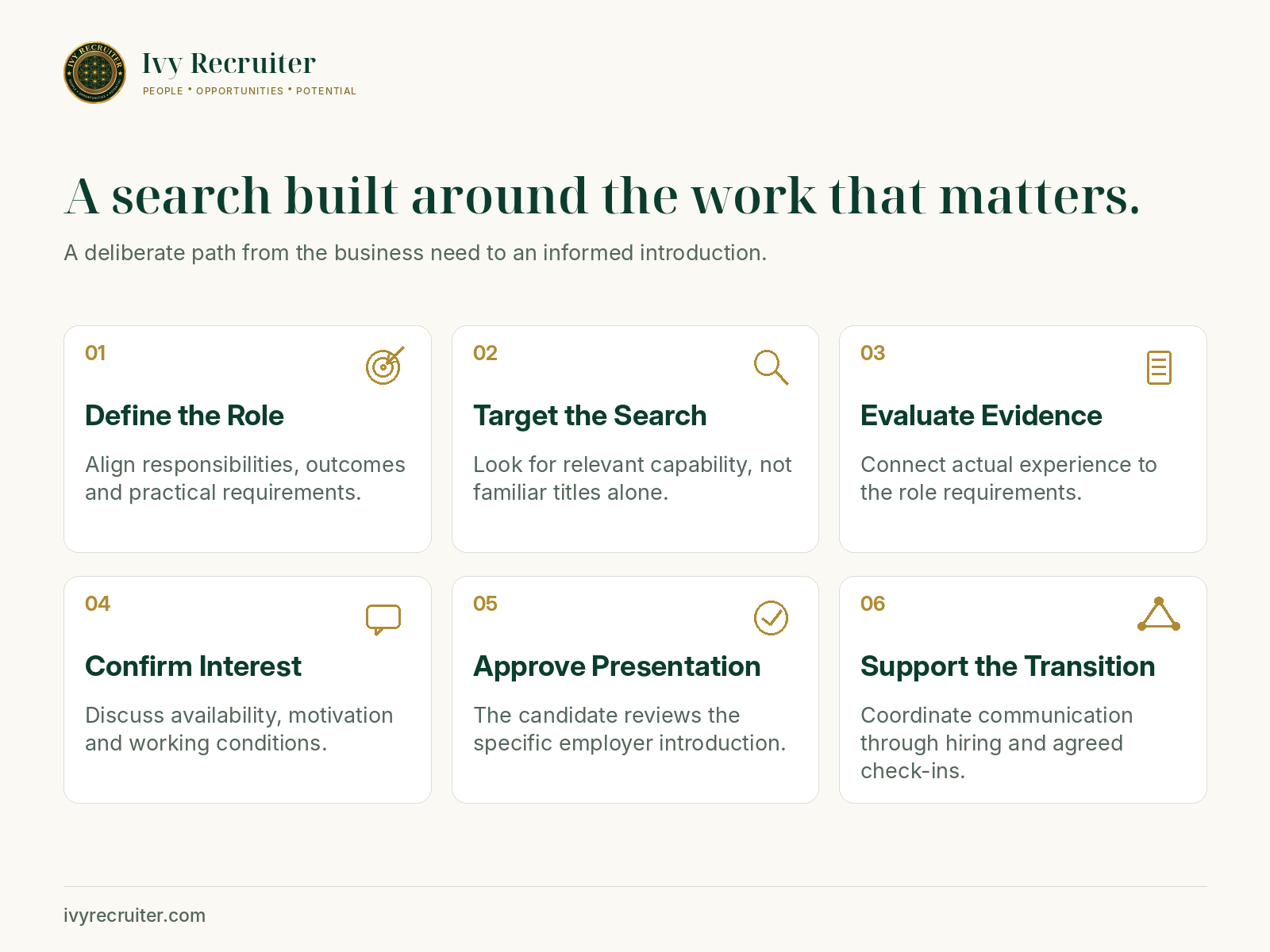
Ivy Recruiter’s employer-paid direct-hire search begins with the responsibilities, expected outcomes, essential experience, practical arrangements, and agreed hiring process.[2]
That makes the search a defined assignment rather than an invitation to send résumés.
Practical service and preparation guidance. Not a guarantee of employment or hiring results.
Look for relevant evidence, not familiar labels
A familiar title can be useful. It is not a complete evaluation.
Two people with the same title may have handled very different work. A professional from another industry may possess relevant capabilities that an overly narrow search overlooks.
The useful questions concern substance: what the person actually did, at what level, under which conditions, and with what contribution.
A recruiter’s role is not to ignore requirements. It is to apply them thoughtfully enough to recognize genuine alignment.
Ivy Recruiter’s search model includes market mapping, sourcing, outreach, and screening against the agreed role. Candidate interest, availability, and working conditions belong in that evaluation alongside professional experience.[2]
A technically credible candidate who does not want the role is not the same as a viable finalist.
Make every introduction explain itself
An employer should receive more than an attachment and a recommendation to “take a look.”
A useful introduction should explain why the candidate belongs in the conversation and what still needs to be examined.
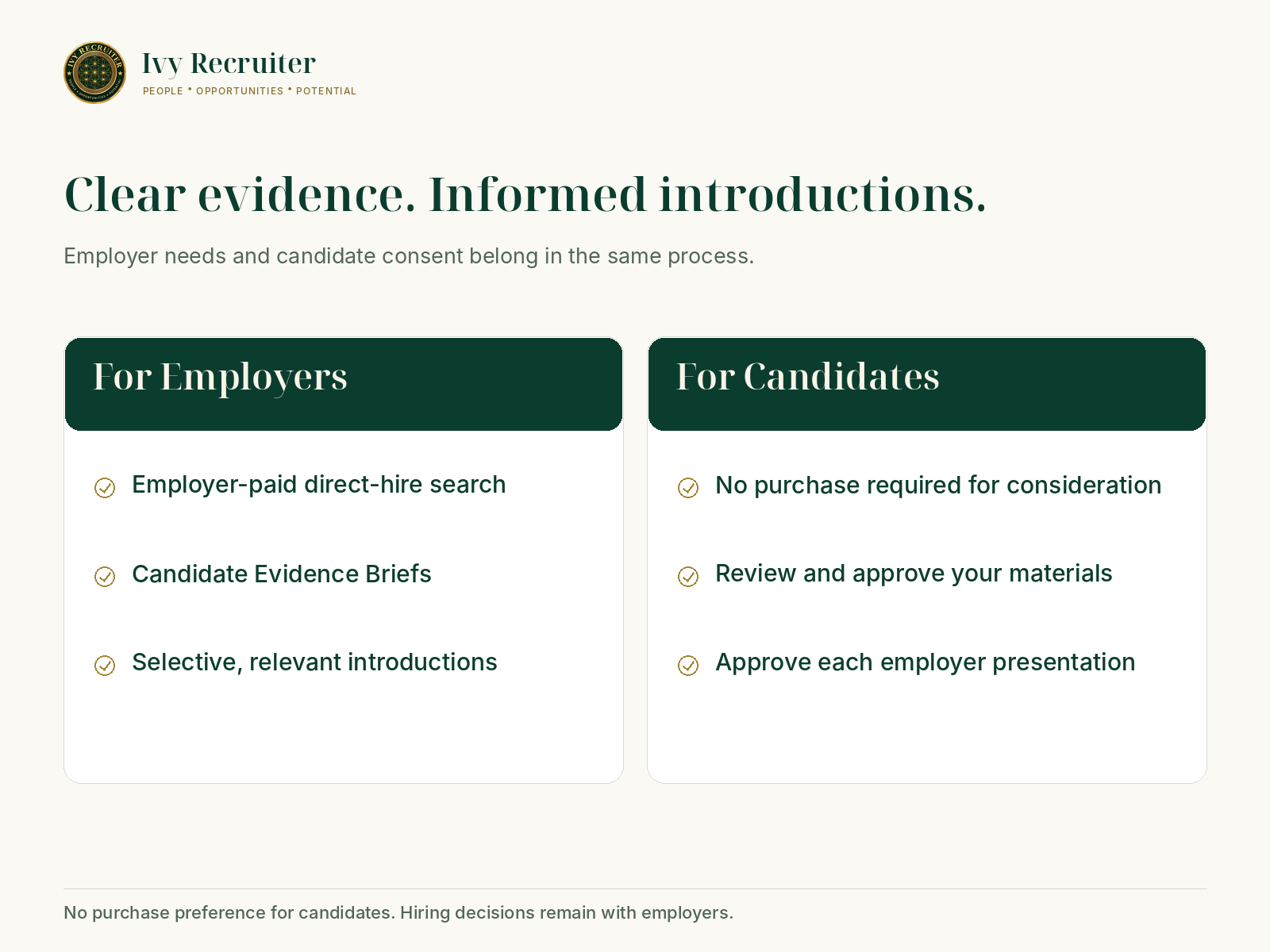
Ivy Recruiter’s Candidate Evidence Brief connects the employer’s requirements with relevant experience, practical alignment, candidate interest, and interview questions. Candidate-reported information is distinguished from independently confirmed facts.[3]
That distinction strengthens the conversation. It helps the employer understand the basis of the recommendation without mistaking a polished document for completed verification.
The aim is a clearer decision: what supports this candidacy, what is unresolved, and which questions should the interview answer?
Present a selective slate, not volume for its own sake
More candidates do not automatically produce a better hiring decision.
If the requirements are clear, a focused group of relevant, interested finalists can support a more purposeful evaluation than a large collection of loosely related profiles.
Ivy Recruiter’s stated target is up to three strong, qualified finalists. Search conditions can affect the slate, and an unsuitable candidate should not be included simply to reach a number.[4]
Quality of consideration matters more than the appearance of search activity.
No purchase preference for candidates. Hiring decisions remain with employers.
Give candidates the opportunity to present their real value
A strong recruiting process also protects candidates from being overlooked because their materials do not explain their experience clearly.
Under Ivy Recruiter’s model, selected finalists receive professional-document preparation at no charge. They review the facts and approve the materials and the specific employer presentation before an introduction.[5]
This is employer-paid recruiting. Candidates do not need to purchase résumé writing, coaching, or a membership to qualify for consideration, and purchasing a separate service provides no preference in the search.
That is an important distinction.
The purpose of preparation is to make relevant experience understandable, not to manufacture credentials or sell access to a hiring decision.
Candidates remain free to decline an opportunity. Employers retain the decision about whom to interview and hire.
Continue the support beyond the introduction
Recruiting requires communication through interviews, feedback, offer discussions, and the confirmed start.
Ivy Recruiter’s published approach also includes agreed hiring-manager support and check-ins around the first 30, 60, and 90 days. Its 90-day candidate-replacement commitment applies to departures covered by the signed employer agreement; it is not an unconditional retention promise.[4]
The principle is straightforward: both parties should understand the responsibilities, expectations, and next steps.
That understanding is worth building before the first day, not discovering after a mismatch becomes expensive.
Do not let the process hide the talent
A selective hiring market rewards clarity on both sides of the table.
Professionals need to explain their value. Employers need a process capable of recognizing it.
Start with the real business need. Search beyond familiar labels where the evidence supports it. Evaluate candidates against relevant standards. Make the introduction informative, accurate, and authorized.
Don’t overlook the right talent because your recruiting strategy is weak.
Start a recruiting conversation with Ivy Recruiter
Employers can contact keith@ivyrecruiter.com to discuss a professional, management, or executive hiring need and the proposed search scope.
Candidates can review the consideration and presentation model without purchasing a separate career service.
A stronger search begins with a clearer understanding of the work and the people who can do it.
Sources

Practical service and preparation guidance. Not a guarantee of employment or hiring results.
Discuss a Hiring Need: mailto:keith@ivyrecruiter.com
Understand Candidate Consideration: https://ivyrecruiter.com/candidates
[1]: U.S. Bureau of Labor Statistics, Employment Situation, September 2026, released October 2, 2026. https://www.bls.gov/news.release/empsit.nr0.htm
[2]: Ivy Recruiter, Direct-Hire Recruiting Services. https://ivyrecruiter.com/services/direct-hire-search
[3]: Ivy Recruiter, What a Candidate Presentation Should Explain. https://ivyrecruiter.com/resources/candidate-presentation
[4]: Ivy Recruiter, employer-paid recruiting model and replacement coverage summary. https://ivyrecruiter.com/
[5]: Ivy Recruiter, Candidate Applications and Representation. https://ivyrecruiter.com/candidates