
Filling a position is a transaction. Protecting an organization is a responsibility.
By Keith Lawrence Miller, Founder, Ivy Recruiter LLC ·

The recruiting industry seems obsessed with how quickly it can fill a position.
“We filled a hard-to-fill role in seven weeks.”
“Your position has been open for 120 days.”
“We reduced our time-to-fill by 40%.”
These accomplishments are celebrated as evidence of recruiting effectiveness. But somewhere along the way, we have confused filling a position with making a successful hire.
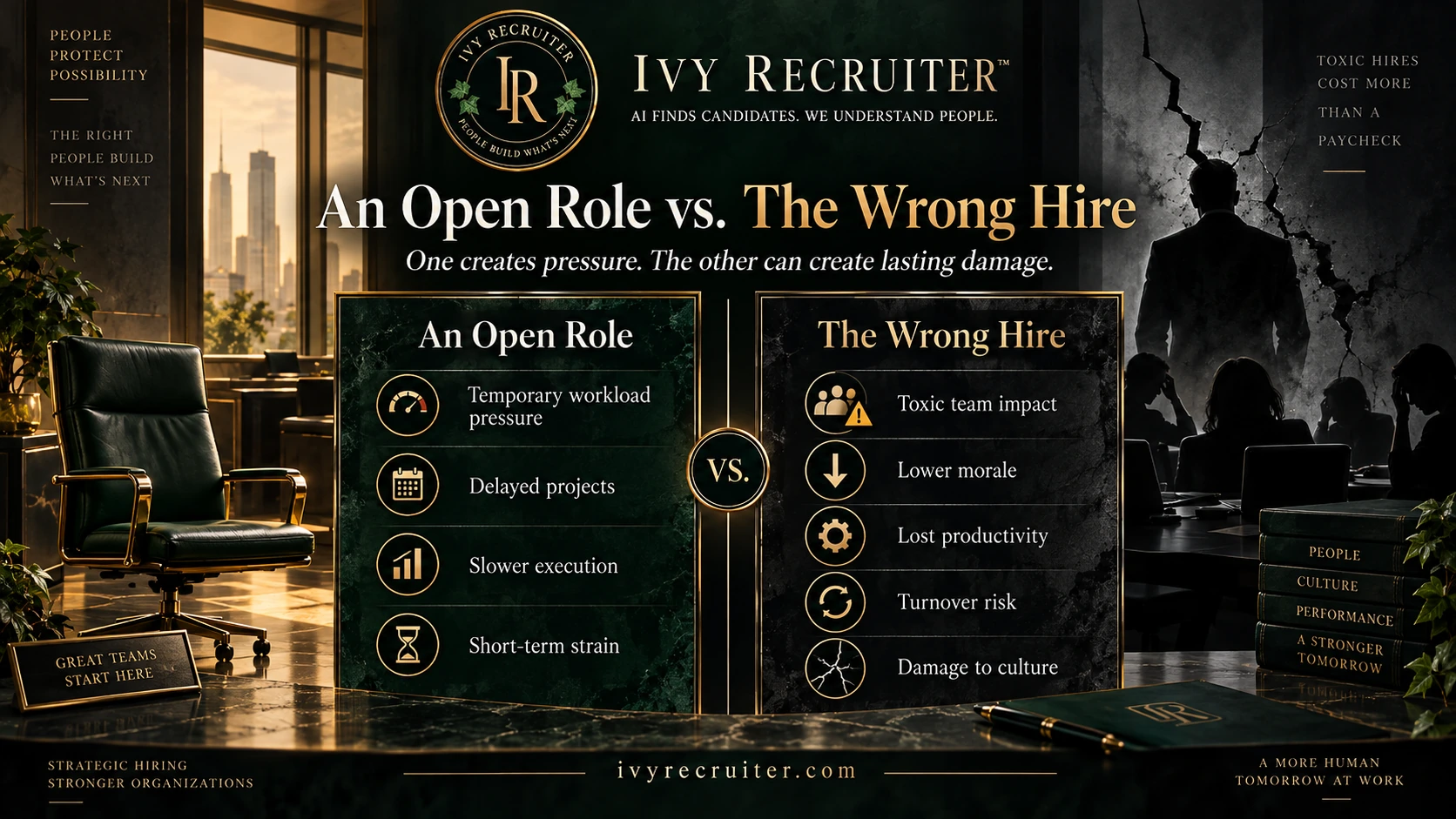
A position that remains vacant for 120 days can be far less damaging than hiring the wrong person who spends the next two years undermining an organization.
An empty position creates an operational challenge. The wrong employee can create an organizational crisis.
There is a difference.
The Cost of a Bad Hire Extends Far Beyond One Employee
Organizations are not simply collections of people performing individual tasks. They are interconnected social systems built around relationships, expectations, values, competence, and shared standards of behavior.
Every employee influences that system.
A capable employee contributes more than their individual output. They solve problems, support colleagues, strengthen accountability, improve processes, and help others perform at a higher level.
The wrong employee can produce the opposite effect.
One individual who consistently undermines colleagues, avoids accountability, creates conflict, or fails to perform can change the entire working environment.
Managers spend time resolving problems rather than advancing objectives. Productive employees compensate for poor performance. Cooperation deteriorates. Morale declines. Talented employees begin questioning why they should continue contributing to an organization that tolerates destructive behavior.
Eventually, some leave.
Now the organization is no longer dealing with one difficult employee. It is dealing with the accumulated consequences of damaged relationships, lost productivity, employee turnover, weakened leadership credibility, and institutional knowledge walking out the door.
The negative effects compound. One poor hiring decision can eventually cost an organization several of its best employees.
This is not simply a theoretical concern.
In the Harvard Business School working paper Toxic Workers, Michael Housman and Dylan Minor examined data involving more than 50,000 workers across 11 firms. Their findings demonstrated that avoiding workers whose behavior harms organizational performance could produce greater benefits than replacing an average employee with a top performer. Source: https://dash.harvard.edu/entities/publication/73120379-08e0-6bd4-e053-0100007fdf3b
The lesson is significant: protecting an organization from destructive behavior is itself a source of economic value.
And when poor hiring decisions become a pattern, the resulting deterioration in performance, retention, and customer service can threaten an organization's competitive advantage.

The Real Estate Agent Problem: When Getting Paid Becomes the Objective
There is an interesting parallel between recruiting and real estate.
Consider a homeowner who hires a real estate agent to sell a property.
The property is listed, but offers are not coming in. The agent begins recommending price reductions. First 5%, then 10%, perhaps eventually 20%.
At some point, the homeowner accepts a substantially lower price.
The agent receives a commission and celebrates the completed sale.
But the financial consequences are not distributed equally.
A 10% reduction in the selling price may represent a substantial loss in value for the homeowner. For an agent earning a percentage-based commission, the reduction in compensation is comparatively small.
The agent's economic incentive to complete the transaction can become misaligned with the owner's interest in protecting the property's value.
Not every agent behaves this way, and a price reduction can sometimes be justified. The issue is the potential conflict between completing a transaction and protecting the client's interests.
The same conflict can exist in recruiting.
A recruiter whose compensation depends on successfully placing a candidate has a financial incentive to complete the placement.
The employer, however, assumes the long-term consequences of that decision.
If the employee underperforms, creates conflict, damages customer relationships, or contributes to the departure of valuable colleagues, the recruiter does not ordinarily bear those operating losses.
The organization does.
This does not mean commission-based recruiting is inherently unethical. It means the recruiter's professional judgment, standards, and commitment to the employer must be stronger than the incentive to close a transaction.
A recruiter should never recommend an unsuitable candidate simply because a search has become difficult or a placement fee is within reach.

A Recruiter Should Be Willing to Say No
Recruiting requires more than identifying someone with the right keywords on a résumé.
A candidate can possess impressive credentials, relevant technical experience, and a history of strong individual performance while still lacking the judgment, interpersonal competence, or accountability required to succeed within a particular organization.
Competence matters. Character matters. Behavior matters.
And so does the ability to work constructively with others.
Protecting an organization's culture does not mean selecting people who think alike, agree with management, or resist change. Strong employees often challenge assumptions and improve established practices.
It means selecting individuals who can perform the work while demonstrating integrity, respect, responsibility, and the capacity to contribute to a productive organizational climate.
An effective recruiter must understand the organization's expectations, leadership environment, performance requirements, and existing challenges before recommending candidates.
They must evaluate evidence of what a candidate has accomplished, how those results were achieved, and whether the candidate demonstrates the capabilities the position actually requires.
They must also have the professional discipline to tell an employer when its requirements are unrealistic, its compensation is uncompetitive, or its hiring process is preventing qualified people from moving forward.
A search that has been open for 120 days deserves examination. It does not automatically deserve a lower standard.
When the available candidates cannot meet the organization's legitimate requirements, the answer is not to lower expectations until someone qualifies.
The answer is to understand why the search is failing, correct what can be corrected, and continue evaluating candidates against the requirements that genuinely matter.
Sometimes the responsible recommendation is not to hire.
The Vacancy Has a Cost. The Wrong Hire Has Consequences.
There is no question that vacant positions create challenges.
Projects can be delayed. Existing employees may face additional workloads. Customers may experience slower service. Revenue opportunities can be lost.
These consequences matter, and a responsible recruiter should work diligently to minimize them.
But hiring the wrong person does not necessarily solve those problems. It can replace a temporary staffing shortage with a much larger and more persistent organizational problem.
The goal should never be to keep positions open unnecessarily. It should be to fill them as efficiently as possible without sacrificing the quality of the decision.
A seven-week placement that fails after three months is not automatically a better recruiting outcome than a 120-day search that produces a capable employee who contributes for years.
The hiring decision must be evaluated by what happens after the employee arrives.
Does the person perform? Do they strengthen the team? Do they improve organizational capacity? Do they contribute to the company's objectives without undermining the people responsible for achieving them?
These are the outcomes that determine the value of recruiting.
Choose a Recruiter Who Protects Your Organization, Not Just Their Commission
Organizations invest years building their reputations, relationships, operating capabilities, and cultures.
Those investments deserve protection.
At Ivy Recruiter, our approach is built around selective candidate presentation, evidence of relevant experience, and a clear reason behind every introduction. We do not believe in adding unsuitable candidates simply to fill a slate.
The objective is not to present the greatest number of résumés or celebrate the fastest placement. It is to help employers make informed decisions about the people they bring into their organizations.
Hiring should strengthen the organization, not merely increase its headcount.
Before selecting a recruiting service, employers should examine how candidates are evaluated, how concerns are communicated, and whether the recruiter is willing to recommend continuing the search when the available candidates do not meet the organization's needs.
A recruiting partner should care about the organization's success long after the placement fee has been paid.
A vacant position is visible. The damage caused by the wrong hire can spread quietly throughout an organization for years.
The true measure of recruiting success is not how quickly a vacancy disappears.
It is how much stronger the organization becomes because of the person who fills it.
Ivy Recruiter LLC
AI Finds Candidates. We Understand People.
Professional, management, and executive recruiting throughout the United States.
keith@ivyrecruiter.com